
Fermentation is everywhere right now. Supermarket shelves are full of kombucha, kefir drinks, gut shots and products promising billions of bacteria. Social media is packed with sourdough starters and fermented food trends.
But fermentation didn’t begin as a wellness movement. It began because people needed food to last, and there’s no better time of year to remember that than Samhain.
On the evening of 31 October, long before anyone carved a pumpkin, Irish households marked the end of the harvest and the start of winter, the “darker half” of the year. Cattle came down from their summer pastures, families took stock of what had been gathered and stored, and everyone got ready for the long, lean months ahead.
Milk was never wasted
Before refrigeration, food spoiled quickly. Milk turned sour, vegetables went soft and bread went stale. Fermentation was one of the simplest ways to make food last longer.
In Ireland, that story is mostly about milk. For much of our history, milk and the foods made from it sat at the centre of the diet. In early Ireland these dairy foods were known as the “white meats”, or bánbhianna. Milk was drunk fresh, but a huge amount of it was soured, churned and turned into something that would keep.
One early visitor described the Irish as “the greatest lovers of milk I ever saw”. They took it about twenty different ways, and they seemed to like it best once it had soured.
That soured milk even had its own name: bainne clabair, or clabber. Milk left to thicken and sour naturally became a food in its own right. (Many of our customers say our kefir reminds them of soured milk they had as children). Churning produced butter, and the liquid left behind was buttermilk, which found its way into drinks, porridge and, eventually, bread.
This wasn’t about optimisation or wellness. It was practical: it helped people waste less, store food through winter and make what they had go further.
Butter in the bog
Some of the most remarkable evidence of this comes out of Ireland’s bogs. More than 500 finds of “bog butter” have been recorded around the country. These are lumps of butter, sometimes wrapped or packed into wooden containers, buried in peat anywhere from the Bronze Age to the early modern period.
Nobody knows for certain why people buried it. It may have been to keep it safe for leaner times, to change its flavour, or as an offering. Either way, the cool, airless bog worked as a natural store long before anyone had a cold room. Turf-cutters still occasionally dig up a block, and some have turned out to be thousands of years old.
Not just milk
Milk wasn’t the only thing people kept this way. All over the world, fermentation turned everyday ingredients into food that would last through the colder months:
- Cabbage became sauerkraut in Germany and Eastern Europe, and kimchi in Korea.
- Tea became kombucha.
- Flour and water became sourdough, long before packets of dried yeast.
- Grain and honey became ale and mead.
- Oats were fermented too.
In Scotland, oat husks were left to soak and sour for several days to make sowans, a porridge-like dish that turned up alongside barmbrack and champ in Halloween fortune-telling games across the Gaelic world.
Each culture had its own version, shaped by whatever grew locally and whatever the climate allowed. In Ireland, with our green grass and dairy herds, it was mostly milk.
Bread that rose on fermentation
Fermentation shows up on the Samhain table too. The báirín breac, or barmbrack, is a speckled fruit loaf traditionally leavened with yeast. The “barm” in its name is thought to refer to the froth skimmed from fermenting ale, which was used to raise bread before bicarbonate of soda arrived.
At Halloween the brack became a fortune-telling game. A ring, a coin, a pea, a stick or a scrap of cloth was baked inside, and whatever turned up in your slice was said to hint at the year ahead. (These days, most shop-bought bracks only carry a ring.)
Once bicarbonate of soda reached Ireland in the 1830s, buttermilk took on a new job. Its natural acidity reacted with the soda to raise bread quickly, and that’s how Irish soda bread was born.
Fermentation was a skill, not a product
One thing that often gets lost in modern food culture is that fermentation used to be something people did themselves. You churned the butter. You fed the starter. You tasted the batch and adjusted as needed.
It was never meant to be perfectly standardised. Every batch was slightly different depending on the season, the temperature, the milk and the culture being used.
That’s very different from many modern fermented products, which are made to taste and behave exactly the same every time. Consistency makes sense for large-scale production, but it changes the nature of the product itself.
Where kefir fits in
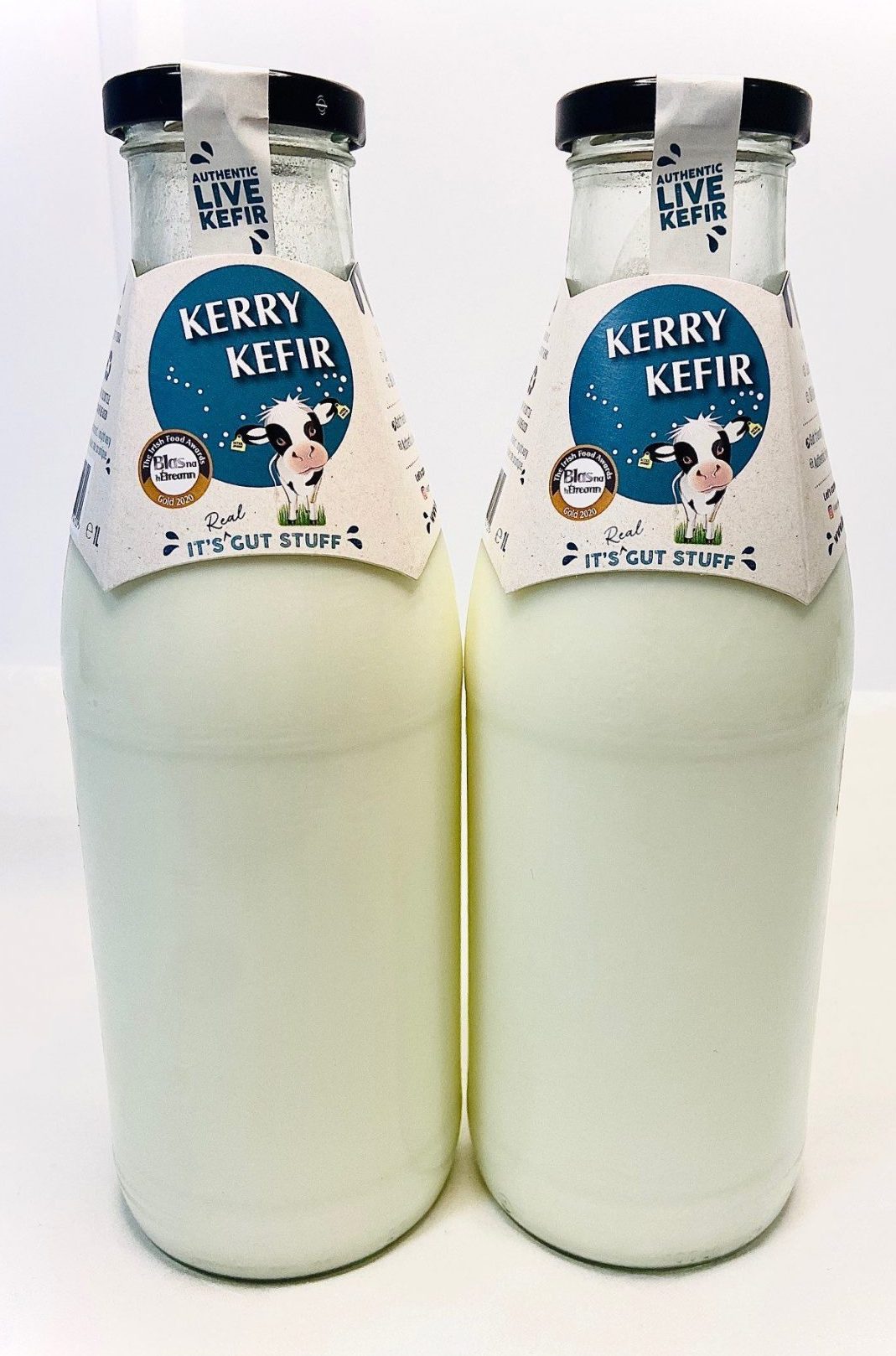
Kefir isn’t originally Irish; it comes from the Caucasus mountains. But when I first started fermenting milk with live kefir grains, it felt very familiar. It’s the same basic idea our great-grandparents understood: add a living culture to milk, give it time, and it becomes something different.
Traditionally-made kefir is produced using live kefir grains, a living community of bacteria and yeasts that ferments milk naturally and is used again and again, batch after batch. Most kefir on supermarket shelves today is made with powdered starter cultures instead, designed for consistency and a longer shelf life. That’s why so many taste more like a drinkable yoghurt than traditional kefir. (You can read more about kefir grains vs powder here.)
Like the sour milk and buttermilk of old, our kefir isn’t perfectly uniform. It carries on fermenting after bottling, so it can thicken, separate a little or become fizzier over time. Independent testing even showed us that the balance of strains in our kefir shifts between summer and winter batches. It’s slower, less predictable and more work, but for us that’s the point. It’s real fermentation, shaped by the seasons, just as Irish diets always were.
A simpler way of looking at food
There’s no doubt interest in fermented foods has grown because of research into the gut microbiome. Honestly, we love that. The science is fascinating, and it continues to explore how fermented foods may play a role in overall wellbeing.
In one 2021 Stanford study published in Cell, adults who ate more fermented foods, including kefir, over ten weeks saw an increase in the diversity of their gut bacteria and a drop in several markers of inflammation. The researchers suggest that fermented foods may help support a more diverse gut microbiome, though it was a small study and more research is needed.
Foods that sat in Irish kitchens for centuries are now often sold as premium wellness products, marketed through numbers, claims and optimisation. The conversation can become so focused on what food does that we lose sight of what food actually is.
Samhain is a good reminder. Fermented foods were never supplements or performance products. They were simply ways of preserving and preparing food, using natural processes that people passed down through generations.
Bringing a little of Samhain into your kitchen
- Bake with it. Kefir can stand in for buttermilk in soda bread and scones. Try our kefir bread recipe.
- Make it part of your autumn breakfast. Pour it over porridge or granola, just as buttermilk once went into oats.
- Keep an eye on the fizz. As the evenings get colder, keep your bottles in the coldest part of the fridge and open them gently. Our Kefir Care guide explains why.
- Revive the brack game. Wrap a ring in parchment, bake it into your barmbrack and see who finds it.
Before fridges, fermentation was how Irish families made the most of what they had. It wasn’t glamorous, but it was clever, careful and deeply rooted in the seasons. I love that a little of that tradition still lives on in every bottle we make here in Kerry.